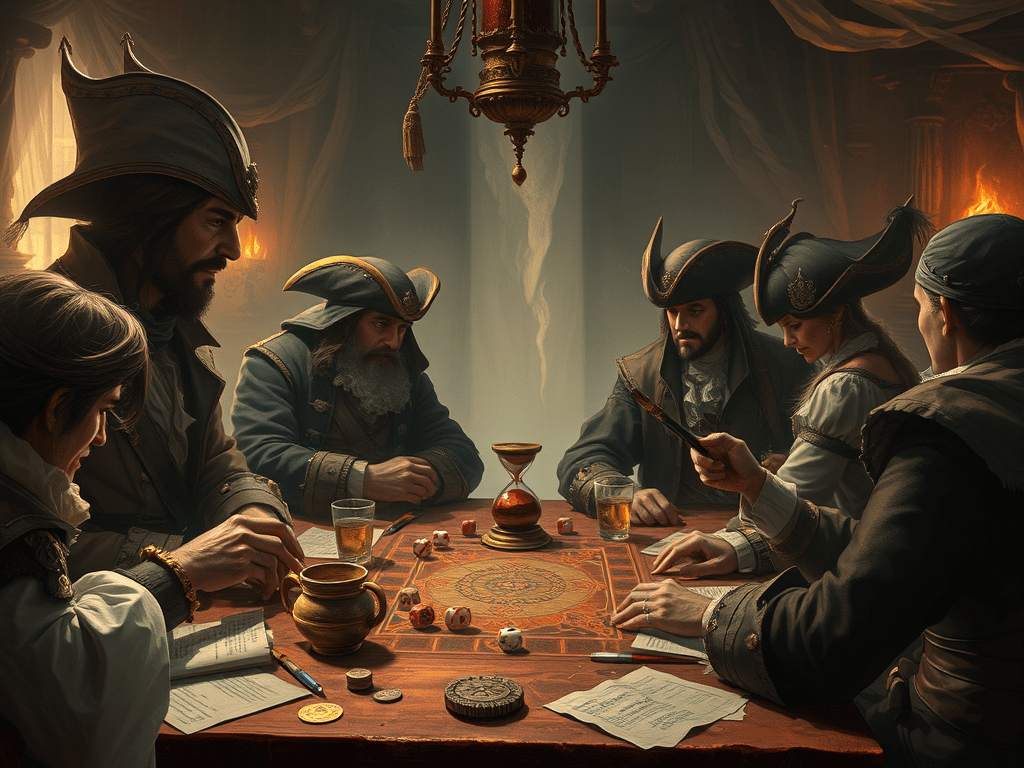
Chassis is my attempt at an RPG ruleset. This is definitely one that I’m doing to understand the way RPG’s work. I want to come up with a working set of rules for a crunchy semi-classless fantasy-themed RPG system. I’m currently looking at magic systems and skill systems and how character advancement can follow a Do It to Advance It ethos. If it works I’ll be, more baffled than surprised.
What I’m tyring to do here, I think (and if you find the uncertainty and tentativeness annoying, imagine being me, imagine, if you will, being my wife), what I’m trying to do here is to learn how and why table-top role-playing games work by designing my own. For the Chassis system that means designing my own rule system. To design my own rule system, I must make design choices. Decide what components of a TTRPG to include, which to exclude and how to combine them in to a whole. Picking something means not picking something else.
How and why to pick one component over another? I think this should be grounded in the experience I want the players to have. By making these choices for myself I will learn how and why those choices are made and what design considerations go in to making those choices. The first decision is to decide what the desired player experience is.
Once I have a design ethos I can experiment with the different components of a table-top RPG to see which fit the design ethos I have chosen. I will generally take a taxonomical and hierarchical approach to this. This Class of solution exists. It has these variants, parameters, contours, shapes and attributes. It does these things well. These things badly. Which is best for me? I am not in the business of trying to invent novel solutions. I suspect that in the 50 years since the genesis of Dungeons and Dragons someone has probably come up with pretty much every possible dice mechanic, rule-set, procedure, game loop or sub-system possible. I am constraining myself to picking; analysing them and picking amongst them with perhaps an element of bespokaneering. There is perhaps something of the optician in this. Does this solution for this component fit better, or worse, better or worse? Better? Or worse? What frames would you like?
What is the experience that I wish the players to have? Or what design constraints am I binding myself to as part of this learning experience, there being no actual players in mind.
Play to Find Out; Play to Progress. I want the players to develop their characters by using them and for the use the players put their characters to to be reflected in that character. If you want a character that is good at fighting, then they should fight and they should get better at fighting by fighting. Who is your character? What is your character good at? Let’s Play to Find Out. What makes them a richer, stronger, more powerful, more interesting character? Let’s Play to Progress.
Alongside this I want to bring some sympathy between mechanic and diegetic elements of the game. The in-fiction story should support the ex-fiction rules. Those in turn should support the in-fiction story. Why is this character mechanically good at hitting things with a sword? Because in character they have experience of hitting lots of things with swords and out-of-character, their player has made player choices to advance the character as a sword-wielding expert by having the character hit lots of things with a sword. If you want a character who is an expert at wielding a sword don’t just pick a Fighting-Man, be a Fighting-Man (or a Fighting-Dwarf with a beard). Through this I want to find some sympathy between role-playing and roll-playing, between player skill and character skill.
My first design choice is that Chassis will be a formally Classless system. Instead I am going to atomise the abilities that are aggregated in many systems to make a class.
I also want to avoid a large formal skills and feats system in lieu of a class system but keep some linkages between the overall type of character and their abilities. That some character choices are easier to make, if you want an Atypical character you, the player, will need to apply some player skill to running your character.
Have I re-invented Pathfinder? Very probably.
I am provisionally using a toolkit I call By My STAFF and BEARD to organise these abilities – more anon.

A secondary reason for the design choice of a formally Classless, atomised ability system is that I want groups of players to be able to reward the play style that they have agreed upon before they started. Do you want to be a Murder-Hobo? Well, if you don’t pay attention to where the XP-Fairy got its gold that’s what will happen. By breaking up the elements of a class I should be able to progress these independently and in different ways and not rely on suspect sources of XP.
I chose to do these things, not because they are easy, but because they are hard.
 The Misadventures of Hareng Rouge
Leave a comment