What is this Blog For?
I like to play tabletop role playing games. Even more than that I like understanding how tabletop role playing games work. I used to perform improv, but it wasn’t until I taught improv that I understood enough about improv theory to be competent at performing. I want to understand how tabletop role playing games are designed. To do that I need to have a go myself and explain myself, to myself, along the way.
So this is a learning by doing project. A project for my own education and knowledge. I’ve no great pretension or aspiration for the quality of the outputs. If you’ve come here for insight then you, you’re fishing in the wrong water for the wrong fish.
I will be content if after a few years I know more than I did and perhaps enough to do some thing in earnest.
How I Am Going to Approach This
I am going to undertake half-a-dozen RPG related projects to help me understand the design principles of roleplaying games.
It would be nice if these project lead to something useful and tangible or engagement with other people but mostly these are my notes about what I’m thinking and learning about RPGs. I’m going to try and write these as if they were for an external audience.
Two reasons, firstly a bit of self-discipline, secondly, if anyone wants to engage I’d like them to have something of a reasonable quality to engage with.
But I’m not here to tell you how to do things. I don’t know. I’m here to find out what I think works for me. If listening to me talk to myself helps you, that’s great. If you you want to join in the conversation that’s even better.
Let’s Play to Find Out
A common feature in my work is the use of procedural generation as a tool to provoke improvised structured content. I want to be able to produce useful gameable content. Content which supports player lead engagement whilst reducing the burden of preparing and running that content and supports collaborative and imaginative emergent gameplay.
One of the things I learned from performing and teaching improv to adults and rugby to children is that having good structures helps. By stratifying and compartmentalising the decision space you can reduce the cognitive load on decision makers so that decisions can be made swiftly and with expertise. A good paradigm for that compartmentalisation should push decisions down and outwards towards actor and should allow actors to quickly refocus from level to level and from compartment to compartment. I think that’s probably true for RPG design as well.
So start with some theory, some container, some structure, some prompts or problems and play to find out if your solution works.
Let’s see if that turns out to be a manifesto or an indulgence.
Current Projects
Pavements and Princes – doing to urbancrawls what Westmarchs did to hexcrawls.
Dungeon 11001 – my project to collect or develop a toolkit for generating, presenting and running a sandbox dungeoncrawl, at least a small one.
Ochtarcy – an Italian renaissance themed RPG setting.
Walk on Part in a War – my design project for a series of adventures. These adventures share two common elements: complex conflicts and Unfolding Fractal Adventure.
Chassis – an RPG rule set, crunchy semi-classless fantasy-themed .
Hexnut – my project to collect or develop a toolkit for generating, presenting and running a sandbox hexcrawl.
How the Blog Works
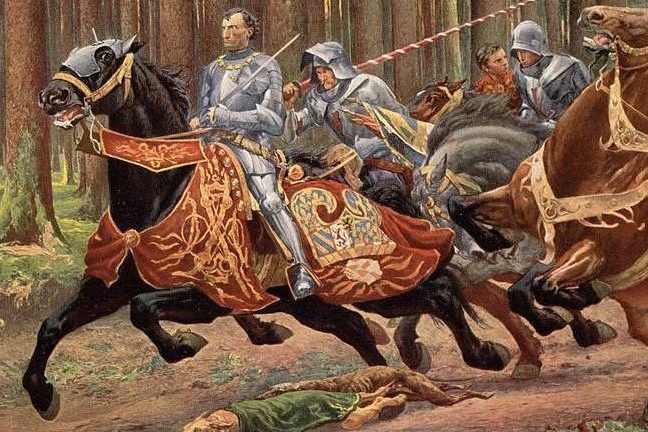
Badly, frankly I think WordPress might be a mistake. So far I’ve not found it very easy to use. I suppose I’ll add learning how to use the bloody software to the list of things I need to learn to make this project work. Good thing I’ve got a badly cropped public domain image of probably Charles the Bold on a horse.
Blog posts will come incrementally, when I can find time to post them. I’ll actually write them in Word and then post them to WordPress when I have the energy to fight the software.
Organisation of the Blog
Each of the blog posts will form part of a project. Within each project there will be chapters. TBy conclusion of the project the posts should fall out to be structured like a short book. Firstly, learning how to work the tags system.
 The Misadventures of Hareng Rouge