I came across this post by Sam Sorensen on legwork, silver medalist in the 2024 Bloggies and I thought “No, but” and then I thought “Yes and.”
I liked it.
It made me think about the difference between an urbancrawl, a streetcrawl and other city-based structures and also what the best way to support play in a city, in an urbancrawl, is.
Sorensen’s post starts by talking about detailed large urbancrawls. That’s where I was thinking “No, but” but it’s really about writers and designers actually doing hard work to produce quality content. Which I agree with. It’s a constant theme of Prince of Nothing’s review at Age of Dusk; content that has been written for you should be better than stuff you can make up yourself. It’s a weakness of improv or winging it that the output can lack pleasing combinations of depth, interconnectedness and coherence between the tactical game objects (encounters, NPC’s, locations) and the wider themes and structures of the game. If your published content is no better than a GM can produce with some random tables what have you done of worth? If all you have produced is some random tables for someone else to use have you done enough work?
As Sam Sorensen says
Legwork is hard. It’s basically all the boring or fiddly or tiring parts of writing up an imaginary place
So I agree, writers and designers should do the work to produce better things
What then in life is best?
And this is where I come back in through the door I first entered. What is better in an urbancrawl? Sorensen praises the volume and detail of work in the Judges Guild City of the Invincible Overlord, which is a huge and detailed work. I think it is a work of streetcrawl. I think a streetcrawl is different from a unbancrawl. I think a streetcrawl misses the essence of what it is to be a city. It treats a city like mega-dungeon.
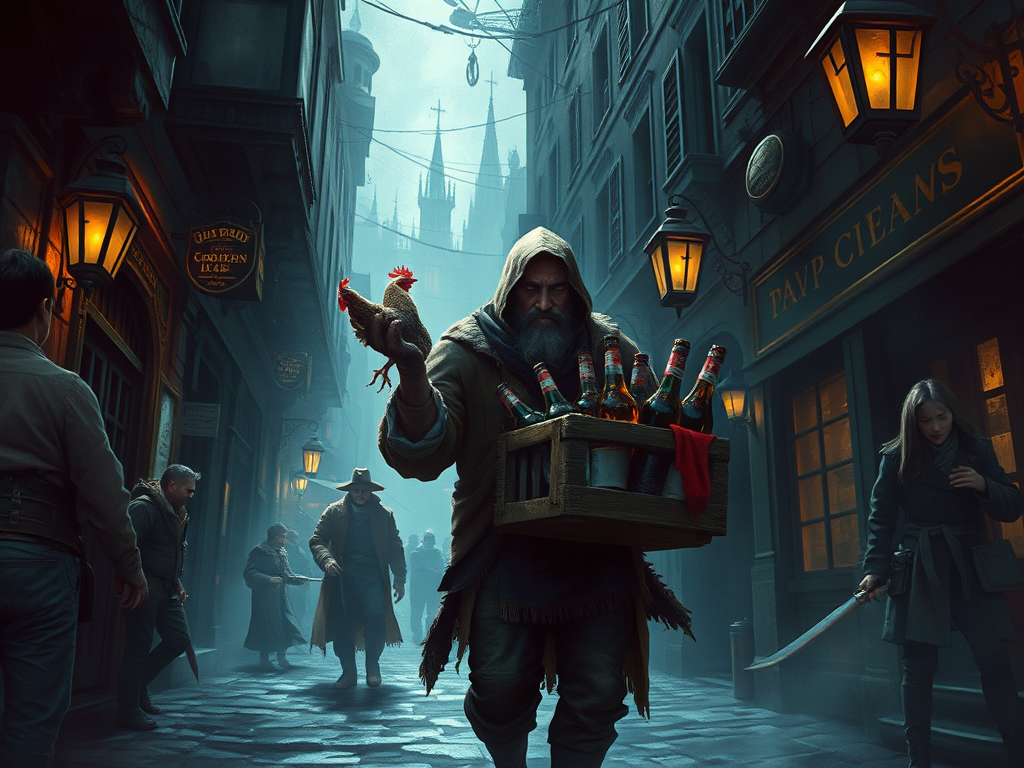
Cities are technologies that allow humans who do not know each other to live and work closely together. Cities are logistical solutions but, in their essence, they are bundles of trust mediation tools. I don’t know you, you don’t know me, neither of us know Ruprect the Unreliable but we must work together. Currency exists in cities so that I can trade my chickens to you and then buy potions from Ruprect without having to set up the complex network of simultaneous barters. Standardised and regulated weights and measures and marketplace inspectors exist so that we all can reliably buy and sell commodities. City guards and court systems exist so that disputes can be settled and to deter the starting of disputes. If you cheat the system the city will find you and punish you, so don’t even try. Cities thrive on, and are designed to produce, law and its less good-looking beefier cousin, order. Consequently, the streets are orderly. The streets are safe. The streets are boring. They ought to be boring. They are full of witnesses and staffed with people who will respond to those witnesses. Orcs may or may not be allowed in your city but murderhobos and wolves are not.
I think City of the Invincible Overlord is a streetcrawl. A detailed, almost house by house, street level depiction of a city.
There’s a problem with the overwhelming size of a city. If you completed Dungeon23 and created your own mega-dungeon you will have in the order of 360 keyed locations and perhaps half as many encounters and interactions. I could throw a stone from my window and hit 360 locations right now but I won’t because the police would arrest me for vandalism.
At its height a million people lived in Rome and most of them never killed a goblin. Any city worth the name is going to be huge and any book about that city is also going to be huge and dense and static. Most of the content won’t be used. If your party turns left up Lime Street instead of right down Creamwave Way, then all the prep of Creamwave Way is wasted. Unless they return to Creamwave Way but then you have to work out how Creamwave Way has changed in the days or weeks or months since the PCs were last in the area. Ruprect the Unreliable, alchemist and producer of life enhancing chemicals, lives at 222b Creamwave Way says the book. Except he doesn’t now, because three weeks ago the PCs got a job from Big Merv the Huge to run him out of town and he’s now in hiding.
If your city functions anything like a real city most of the locations are safe and dull, most of the people are not interested in you, or you in them. Most interactions are standarised. Ordinary people don’t want to interact with you in an interesting way.
As you move around that city you ought to be safe unless you are involved. Involved in what?
The interesting thing about a city is the network of relationships. What I think makes an urbancrawl an urbancrawl is the connection between those networks of relationships and the physical elements of the city. By exploring and interacting with the physical setting of the city you also explore and interact with the social webs of the city. That’s the distinction between an urbancrawl and a streetcrawl for me. If, in a Dungeoncrawl you explore locations in a larger restricted and enclosed hostile structure and in a Hexcrawl you explore locations in a larger wilderness in an Urbancrawl you explore locations in a larger social, political, factional network with a city.
What then in life is best?
I don’t know, but what I’m trying to create in Pavements and Princes is a procedural toolkit that will produce and manage a series of suites of locations tied to their social context. That series should be fractal; the city is a layer cake and you should be able to move up and down the layers using the same toolkit to create content. The toolkit should manage the lifecycle of different parts of the content, their creation, interactions, change, growth and ultimate destruction. The content that it produces should be informationally dense, rich and useful when unpacked. It should provide ways and means for players to interact with the content. That content and those interactions should arrive Just-in Time for use at the table but also be nested in to a coherent structure that has an ongoing narrative life.
That’s what I think and I’m grateful for the original post that game me the provocation to think “if not That, then What?”
More of the What to follow.
 The Misadventures of Hareng Rouge
Leave a comment