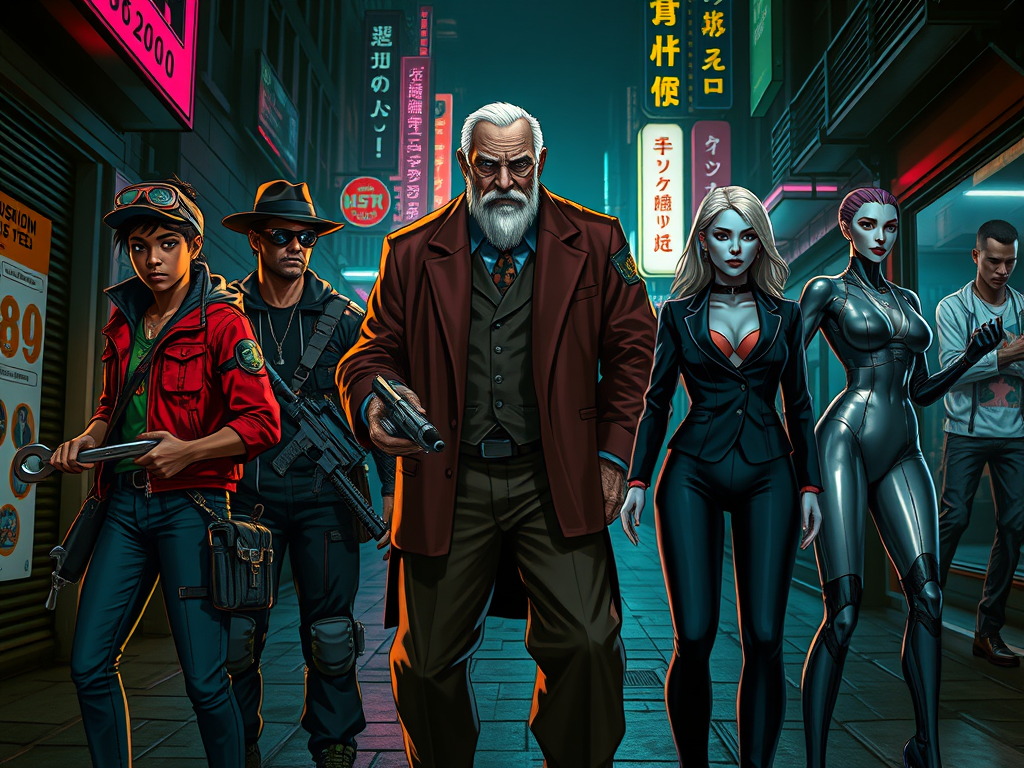
I’ve been playing a lot of Cyberpunk 2020 recently. My group just finished our first full campaign, Land of the Free, and we’ve started on our second, Tales from the Forlorn Hope. I’ve been thinking about how character progression works in Cyberpunk 2020 — by which I mean improvements in a character’s ability to get things done: to hit harder or smarter, run faster or longer, make better things, impact the world more effectively, or resist its impacts more successfully.
The classic model of character progression in role-playing games is the Dungeons & Dragons standard: Experience Points and Levels. Gain XP, use that XP to increase your Level. Levels bring broad improvements to the character — new abilities or enhanced existing ones, alongside boosts to survivability, lethality, and effectiveness in and out of combat. In D&D, each level-up increases your hit points, meaning your survivability grows in step with your level.
There are plenty of variants on this model. Some systems move faster or slower. Some have flatter progression curves, reducing the power gap between levels. Others add layers of customisation or specialisation, letting players shape their characters through subclass choices, archetypes, or bespoke abilities. But whatever the shape or speed, most of these systems tie progression to reaching a specific milestone — the level-up moment.
Cyberpunk 2020 does things differently. Some aspects of a character remain quite flat. The game’s equivalent of hit points, for example, are relatively static and closely matched to standard lethality. Even experienced characters don’t survive an unprotected headshot any better than rookies.
Where Cyberpunk diverges most from traditional systems is in its skill progression. Skills improve individually rather than as part of a bundled “level.” Checks are made by adding an Attribute (out of 10), a Skill level (out of 10), and a 1d10 roll. Against a Difficulty 20, a +1 in a skill is roughly a 5% increase in success chance — meaningful, but modest. And by the rules as written, skill progression is slow: it could take between 50 and 200 sessions to raise a skill from 0 to 10.
So where does meaningful progression come from? Money and gear.
As your character’s career advances, they’ll acquire equipment — often, as in my case, by looting the dead or stripping value from defeated enemies. My group has reached the point where we’ve collected so many weapons that I barely need more. The cheap rifle I stole early in Land of the Free now lives as a spare in my customised four-wheel drive.
Gear drives capability. My character’s survivability jumped dramatically when I upgraded from a Kevlar T-shirt (SP 10) to a full suit of Metal Gear body armour (SP 25). His flexibility improved as he acquired multiple suits for different jobs — stealth, tech work, heavy combat. Add modest weapon skill increases, accurate firearms, and scopes that improve hit chances, and my character is now roughly 30% more effective in combat.
The same applies outside combat. High-quality tools give +1 bonuses to Tech rolls. Scanners, drones, and sensors extend perception and range. Even something as simple as owning a SCOP tank and a distillation rig enables my character to live off-grid and pursue his own agenda. In short, much of Cyberpunk’s character progression comes not from innate growth, but from the tools a character uses to shape the world.
And I’m okay with that.
One of the things I’m exploring in my Chassis system is the principle of improving skills by using them — both for balance and for enhanced role-play. I think of it in two complementary ideas: USE and PRACTICE.
In many role-playing games, characters don’t improve by sitting still — they grow by doing. Firing a rifle, making a street deal, sneaking past guards — every action is a step toward mastery. I call this the USE principle: Use Skills, Evolve. It’s the simple but powerful idea that experience comes from experience itself — the more you practice a skill, the better you become at it.
Some games reward training, others reward repetition — the best ones make improvement feel like a natural consequence of play. That’s the heart of PRACTICE: Perform Repeated Actions Cultivating Talent, Increasing Character Expertise. Whether it’s forging weapons or taming beasts, growth happens through doing, not waiting. Every pistol shot, tech build, and stealth check is part of the character’s story of improvement.
From a design perspective, use-based progression creates a powerful feedback loop. Every action the player takes reinforces both character growth and player engagement — success feels earned because it’s directly tied to behaviour. The best systems balance realism with reward pacing: progression feels natural, not grindy, and every improvement tells a story about how the character became who they are. In essence, USE and PRACTICE don’t just level up characters — they deepen the player’s connection to the world.
I prefer progression that rewards the player for playing their character as intended, and the character for acting according to their nature. If you want a short-range brawler, invest in pistols and heavy armour — not sniper rifles and stealth cloaks. If you want a support character who shapes the battlefield, use those tools often. Cyberpunk 2020, by the book, doesn’t quite deliver that with its skill system — you earn generic points to spend on any skill. But through money and gear, you still make meaningful choices that reflect your playstyle. Want to be a sniper? Keep the high-end rifle you looted. Want to be a weaponsmith? Buy the best tools you can find.
I’ve come to appreciate how Cyberpunk 2020’s skill system meshes with its gear economy. Together, they make a progression model that’s flat but flexible — one that rewards the way you play, not just how much XP you’ve hoarded.
In future posts I’ll look at another option for character progression mechanics, the goal-based approach. Not just the traditional XP grind, but systems built around milestones or structured objectives, sometimes even laid out like a progression grid or checklist or even a “bingo card” tool. Where USE and PRACTICE focus on what a character does to improve, goal-based progression looks at why they act but what drives them forward. What is the character or the player interested in having achieved. Done well, it can actively support role-playing by aligning character growth with motivation and intent, not just repetition or reward. In future posts, I’ll look at another option for character progression mechanics: the goal-based approach. Not just the traditional XP grind, but systems built around milestones or structured objectives — sometimes even laid out as a progression grid, checklist, or “bingo card” tool. Where USE and PRACTICE focus on what a character does to improve, goal-based progression explores why they act — what drives them forward, and what they or their players want to achieve. Done well, it actively supports role-playing by aligning character growth with motivation and intent, rather than simple repetition or reward
 The Misadventures of Hareng Rouge
Leave a comment